AI That Works Anywhere: How Sanas Brings World-Class Speech AI to Entry-Level Machines
Across the world, millions of people work on entry-level machines or laptops that are five, ten, even twelve years old. In many contact centers, that’s not the exception, it’s the infrastructure. And increasingly, the challenge isn’t just the age of the machine, but the workload it carries. Modern agents operate in a sea of always-on applications — CRMs, ticketing systems, analytics, and collaboration tools — all competing for compute.
For the enterprises they serve, upgrading every device or untangling the growing stack of agent-facing tools across global partners isn’t realistic. Tight margins and cost-center budgets make constant upgrades and wholesale system changes impossible.
That reality creates a quiet but critical barrier to innovation: as AI systems grow more powerful, they often require more processing power. The very technologies that promise to improve service quality can end up excluding the environments that need them most.
Sanas set out to change that.
As SVP of Product at Sanas leading the development of our Speech AI products, I’ve seen firsthand why solving for real-world infrastructure constraints is critical.
From the beginning, our mission has been to democratize speech technology by making speech clarity universally accessible, regardless of hardware or geography. That commitment led to Sanas Lightweight Mode, a scientifically re-engineered version of our Accent Translation model that delivers the same natural, human clarity while running efficiently on entry-level and overloaded machines.
In this article, I’ll give you a look inside how Lightweight Mode was designed, tested, and validated to bring world-class speech AI to the world’s most resource-limited environments. Because AI that performs anywhere empowers everyone to be clearly understood.
The Science Behind Lightweight Mode
When we set out to design Lightweight Mode, we didn’t see it as an engineering challenge, we saw it as a science problem.
Most AI systems improve quality by adding more layers, parameters, and compute power. That works fine in a lab, but not on the endpoints where users actually work. The harder challenge was to deliver the same quality with fewer resources.
Our science team rebuilt the model architecture from the inside out, optimizing each component to minimize CPU cycles and memory footprint. The result is an AI-native design that achieves the performance of our standard Accent Translation model while consuming far less compute power.
This wasn’t about trimming features, it was about designing more efficient algorithms. From signal processing to threading, every element was tuned for efficiency in real-world conditions: variable bandwidth, diverse accents, and limited hardware resources.
Performance means little if it’s difficult to deploy. Lightweight Mode was built for fast, secure implementation on existing devices. Because Sanas runs fully on-device, so voice data never leaves the agent’s machine. Audio is processed locally and remains on the endpoint, reducing exposure and simplifying security, privacy, and compliance requirements. Enterprises and BPOs can deploy directly to users’ machines without infrastructure upgrades or complex IT integration — delivering world-class AI performance efficiently, securely, and at scale.
Proven Under Pressure
AI can look flawless in a lab; the real question is how it behaves when everything else is running.
To test Lightweight Mode in a way that truly reflects day-to-day agent conditions, our Quality Engineering team designed a performance test bench that replicates how CPU load actually behaves on a contact center floor. Instead of jumping straight to a “100% CPU” scenario (which almost never happens in practice) we recreated the gradual buildup of activity that occurs as agents open CRMs, browsers, ticketing tools, knowledge bases, and analytics dashboards.
At each stage of this simulation, we measured speech clarity using the C22 score: a measure of how accurately the model preserves the words being spoken, even under stress. Higher scores mean clearer, more stable speech output. For a detailed definition and explanation of C22 scores, please see the Appendix.
These tests were conducted across hardware configurations commonly found in global contact centers, including both thin-client and legacy machines.
Across more than 30 test machines, from newer laptops to decade-old desktops, Lightweight Mode delivered consistently high performance throughout the entire range of load conditions.
While many AI systems begin to falter as soon as a machine starts to get busy, Lightweight Mode stayed stable even when devices were at full load.
This approach gave us a genuine view into how Lightweight Mode performs in the real, multitasking environment of global contact centers — and it demonstrated something essential: Lightweight Mode isn’t just efficient; it stays reliable when agents need it most.
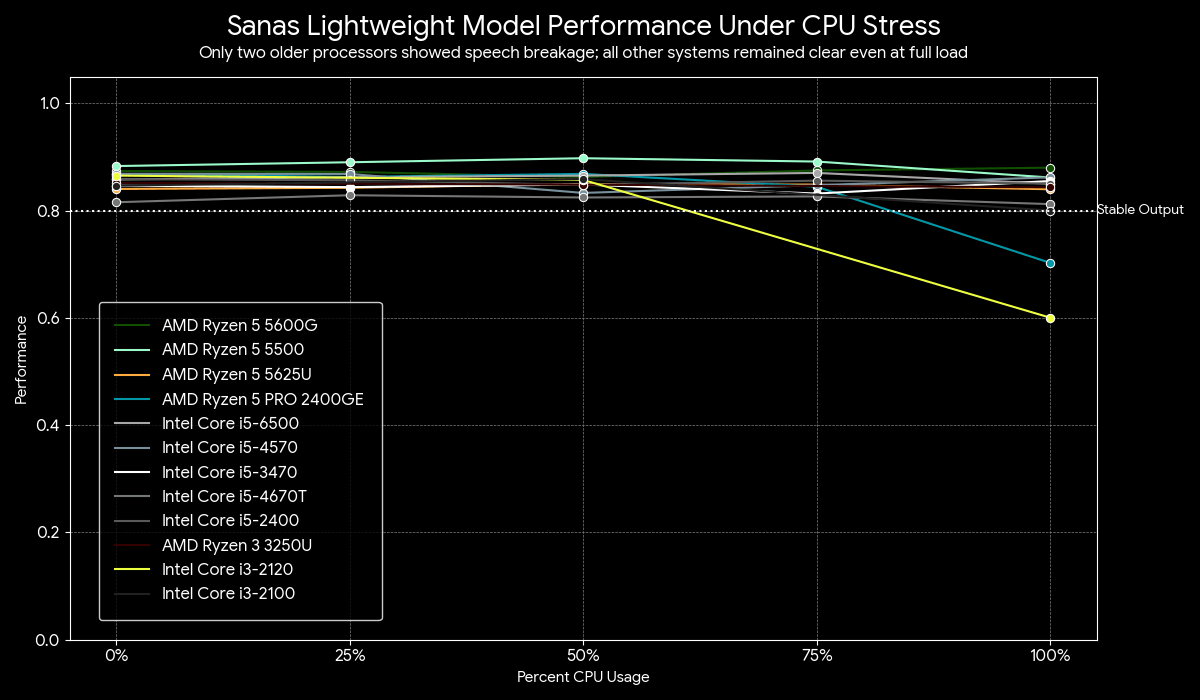
The figure and table below illustrate Lightweight Mode performance across a broad range of processor types. C22 scores above 0.8 indicate stable output, scores between 0.7 and 0.8 exhibit minor degradation, and scores below 0.7 indicate speech breakage. As you review the data, note that only two older processors show meaningful breakdown at maximum CPU stress; every other system maintains clear, natural speech throughout.
AMD Ryzen 5 5600G
3.90 GHz
6 / 12
0.874
0.870
0.872
0.859
0.863
0.875
0.880
AMD Ryzen 5 5500
3.60 GHz
6 / 12
0.883
0.899
0.890
0.887
0.898
0.892
0.862
AMD Ryzen 5 5625U
2.30 GHz
6 / 12
0.841
0.845
0.843
0.837
0.850
0.849
0.840
AMD Ryzen 5 PRO 2400GE
3.20 GHz
4 / 8
0.869
0.863
0.869
0.845
0.703
-
-
Intel Core i5-6500
3.20 GHz
4 / 4
0.858
0.863
0.866
0.871
0.850
-
-
Intel Core i5-4570
3.20 GHz
4 / 4
0.869
0.869
0.833
0.848
0.862
-
-
Intel Core i5-3470
3.20 GHz
4 / 4
0.847
0.844
0.849
0.832
0.855
-
-
Intel Core i5-4670T
2.30 GHz
4 / 4
0.816
0.829
0.825
0.827
0.812
-
-
Intel Core i5-2400
3.10 GHz
4 / 4
0.859
0.857
0.848
0.856
0.851
-
-
AMD Ryzen 3 3250U
2.60 GHz
2 / 4
0.852
0.849
0.844
-
-
-
-
Intel Core i3-2120
3.30 GHz
2 / 4
0.866
0.858
0.601
-
-
-
-
Intel Core i3-2100
3.10 GHz
2 / 4
0.847
0.859
0.800
-
-
-
-
The results validated what the science team set out to prove: that efficiency and quality can coexist. While other models degrade as CPU demand rises, Sanas Lightweight Mode stays remarkably steady. The performance curve is essentially flat, meaning agents and customers experience the same clarity whether the system is idle or working at capacity.
AI that performs reliably on a busy contact-center floor (not just in a quiet lab) is what truly makes a difference.
Why It Matters: Efficiency Is the New Edge
In the world of customer experience, efficiency is more than a technical metric — it’s a competitive advantage.
When AI can deliver premium performance on entry-level hardware, it expands what’s possible for both enterprises and their partners. Sanas Lightweight Mode enables organizations to deploy directly on agent endpoints without waiting on backend integration or infrastructure upgrades. That means faster rollouts, simpler updates, and consistent voice quality across geographies from Mumbai to Manila and Cartagena to Cape Town.
For enterprises, that translates into strategic freedom: the ability to scale operations globally without being limited by device requirements or infrastructure disparities. For BPOs, it means empowerment and inclusion where every agent, regardless of hardware, can deliver the same clarity and confidence on every call.
Our focus on efficiency also reflects a larger shift happening across the AI industry. Even as the cost of compute continues to fall, the pressure to deliver more — faster, with lower latency and reduced energy use — is intensifying. The future of AI won’t be measured only by accuracy or speed, but by how intelligently it uses resources. Models that perform flawlessly in constrained environments (not just ideal ones) will define the next decade of progress.
The Future of AI That Works Anywhere
The real breakthrough isn’t just that Lightweight Mode performs better under stress, it’s that it performs everywhere.
Across contact centers, geographies, and hardware generations, it empowers people to communicate clearly without waiting on new infrastructure or costly upgrades. That’s what makes efficiency a human advantage, not just a technical one.
Because AI that works in real world conditions is more than a performance milestone, it’s progress that matters. Sanas meets people where they are, on the devices they have, and ensures everyone can be clearly understood.
Appendix: What is a C22 score?
C22 is a shortened version of Confidence-Weighted Word Recognition Rate (CW²R²), an enhanced metric that extends the traditional Word Recognition Rate (WRR) or Word Error Rate (WER) by integrating the model’s confidence scores into the calculation.
Instead of treating all words equally, CW²R² weights each recognized word according to the ASR model’s confidence — giving more influence to words the model was confident about, and less to uncertain predictions.
This nuance matters because standard WER or WRR treats every word as equally important, but this can be misleading in real applications like accent conversion, noise cancellation, or speech recognition in variable conditions.
A system might get high WER but still be perceptually correct (if low-confidence words were noise or minor hesitations), or get low WER but sound untrustworthy (if it’s confidently wrong).
CW²R² addresses this by factoring confidence calibration into recognition accuracy, which is why we chose to use C22.