











Why Your AI Agent Needs "Deterministic Ears" to Think Clearly

We're in the agentic era. Today's AI agents don't just respond, they act. They route workflows, trigger transactions, and execute code. As voice becomes a front door to agents in support, banking, healthcare, and beyond, the audio pipeline is increasingly the weak link.
When voice input is noisy, accented, or inconsistent, small errors compound fast. From microphone to ASR to LLM to action execution, a single misheard word can derail the entire outcome. The result often looks like an LLM hallucination, but the root cause is upstream. Your agent heard the word wrong.
To fix how your agent hears, you need to fix what it's hearing. An upstream audio layer that acts as “deterministic ears” can make speech more consistent and machine-readable, so your probabilistic model isn’t forced to guess.
In this article, we'll unpack why audio quality is the most underrated failure point in voice-enabled AI, and how cleaner voice input leads to fewer misunderstandings, fewer tokens, and higher task success without changing your model.
What you’ll learn:
- Why ASR errors look like "LLM hallucinations" in production
- How mishearing drives token costs and operational drag
- Where an audio layer fits architecturally (and what to measure)
The Probabilistic Trap: When "Thinking" Goes Wrong
Modern LLMs are probabilistic by design and these models aren’t hearing raw audio; they reasoning over the transcript your ASR produces. They work by calculating the statistical likelihood of the next token, which is powerful for reasoning but fragile when the input is messy. If the transcript is wrong, the thinking is wrong.
When you feed a probabilistic brain with noisy, accented, or ambiguous audio, you force the model to burn valuable compute just guessing what was said. This is where most teams underestimate the risk: a high Word Error Rate doesn't just mean a typo in a transcript. It means your agent is reasoning from a distorted version of reality.
This isn’t the model being “dumb.” It’s the model being confidently rational about incorrect inputs.
The High Stakes of Hearing: Access vs. Excess
Consider a real-world scenario. Imagine a high-net-worth client with a strong accent calls your AI-powered financial services agent.
What they say:"I need access to my funds." (They're locked out and need to log in.)
What the agent hears:"I need excess to my funds."
One phoneme. Totally different intent.
The agent interprets "excess" as a query about surplus liquidity (”excess” cash available for investment). In real calls, accents, compression, and noise make phonemes collapse, then ASR picks the most statistically plausible word, not the correct one. So instead of unlocking the account, it triggers a "Surplus Management" workflow and starts discussing investment options.
And because agents now act, a misheard word can trigger irreversible workflows: transfers, account changes, or policy updates.
The user is trying to log in. The agent is calmly offering portfolio advice.
The context is lost, the transaction fails, and the customer is frustrated. Your team is left debugging a "hallucination" that was actually an upstream audio problem. Teams then waste cycles tuning prompts and guardrails for what is fundamentally an upstream sensing issue.
This same failure shows up across industries: contact centers ("refund" vs. "replace"), healthcare ("fifteen" vs. "fifty"), IT ops ("restart" vs. "reset"). The words are different, but the pattern is the same: small phonetic shifts lead to big downstream consequences.
The Token Economy: Clarity = Cash
Beyond reasoning errors, there's a hard economic cost to bad audio: token consumption. Tokens are just the meter. What’s really happening is friction: extra turns, longer handle time, and lower containment.
Every time an agent misunderstands a user, it enters a clarification loop:
- Agent: "I'm sorry, did you say excess?"
- User: "No! Access!"
- Agent: "Could you repeat that?"
Each turn of this conversation burns input and output tokens. For high-volume enterprise agents, these redundant loops add up fast. At enterprise volume, even a small increase in clarification turns can become a meaningful annual inference cost, and it drags down resolution rates.
The math is simple:
- Cleaner audio → higher transcription accuracy
- Higher accuracy → zero clarification loops
- Zero clarification loops → fewer tokens consumed
- Fewer tokens consumed → dollars saved
You can measure it with metrics like average turns per successful task, re-ask rate (‘repeat that’), ASR confidence distribution, and cost per resolved interaction.
When your agent hears clearly the first time, it reasons correctly the first time. One shot, not three.
The Solution: Deterministic Input for a Probabilistic Brain
The answer isn't a smarter LLM, it's cleaner input. Better models help, but they can’t reliably recover intent from missing or mangled words.
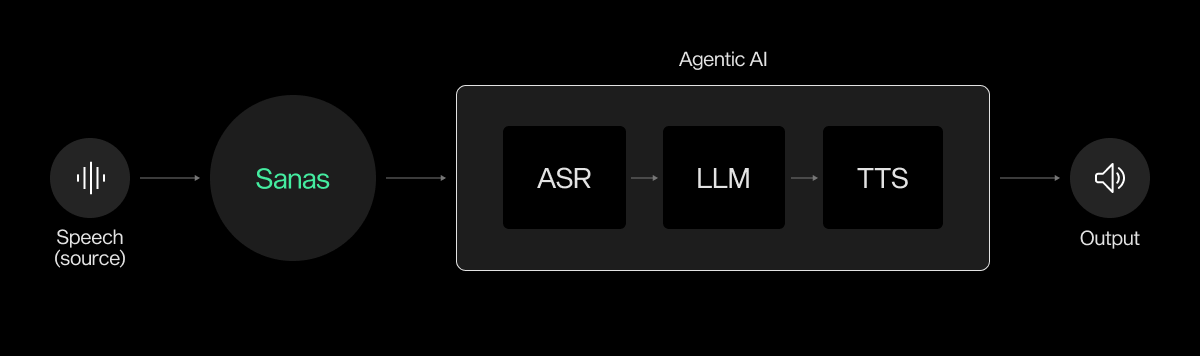
Sanas is a real-time audio processing layer that sits upstream of your ASR and LLM. We translate accents and cancel noise on live audio before your agent hears a single sound. Sanas is designed for real-time latency budgets and drops into existing voice stacks as an upstream audio layer, with no need to rebuild your agent.
Think of it as a deterministic filter for a probabilistic brain. Sanas reduces variance in audio input so the rest of the stack behaves more predictably. Your model receives standardized, crystal-clear speech, regardless of who's speaking or where they're calling from.
For enterprises, maintaining security posture matters. Define where audio is processed, what is stored (if anything), and how data handling aligns with your compliance requirements.
What this unlocks:
- Correct intent detection: "access" stays "access"
- Faster resolution: no clarification loops
- Lower inference costs: fewer tokens per conversation
- Better customer experience: users feel heard the first time
No model changes required: just cleaner input and dramatically better outcomes.
Clean Input, Clear AI ROI
For all the progress we've made in AI reasoning, the input layer remains an afterthought. That oversight is quietly draining your budget. It’s also why many voice-agent pilots stall: teams optimize prompts while the input distribution stays chaotic.
In a landscape where proving AI value is genuinely difficult, input clarity offers something rare: a measurable win. Killing clarification loops cuts your token bill. Ensuring correct intent detection improves success rates. These translate directly into numbers your CFO will care about.
If you improve first-pass understanding, you typically improve metrics leaders already track: boosting containment, reducing AHT (Average Handle Time), and increasing task completion (resolution time).
The most impactful AI investments right now aren't always the most complex. Sometimes it's about fixing the fundamentals.
Ready to give your agent clearer ears? Request access to the Sanas SDK.