











CX Statistics for 2026: What the Data Says About Agent Experience, Communication Clarity, and AI

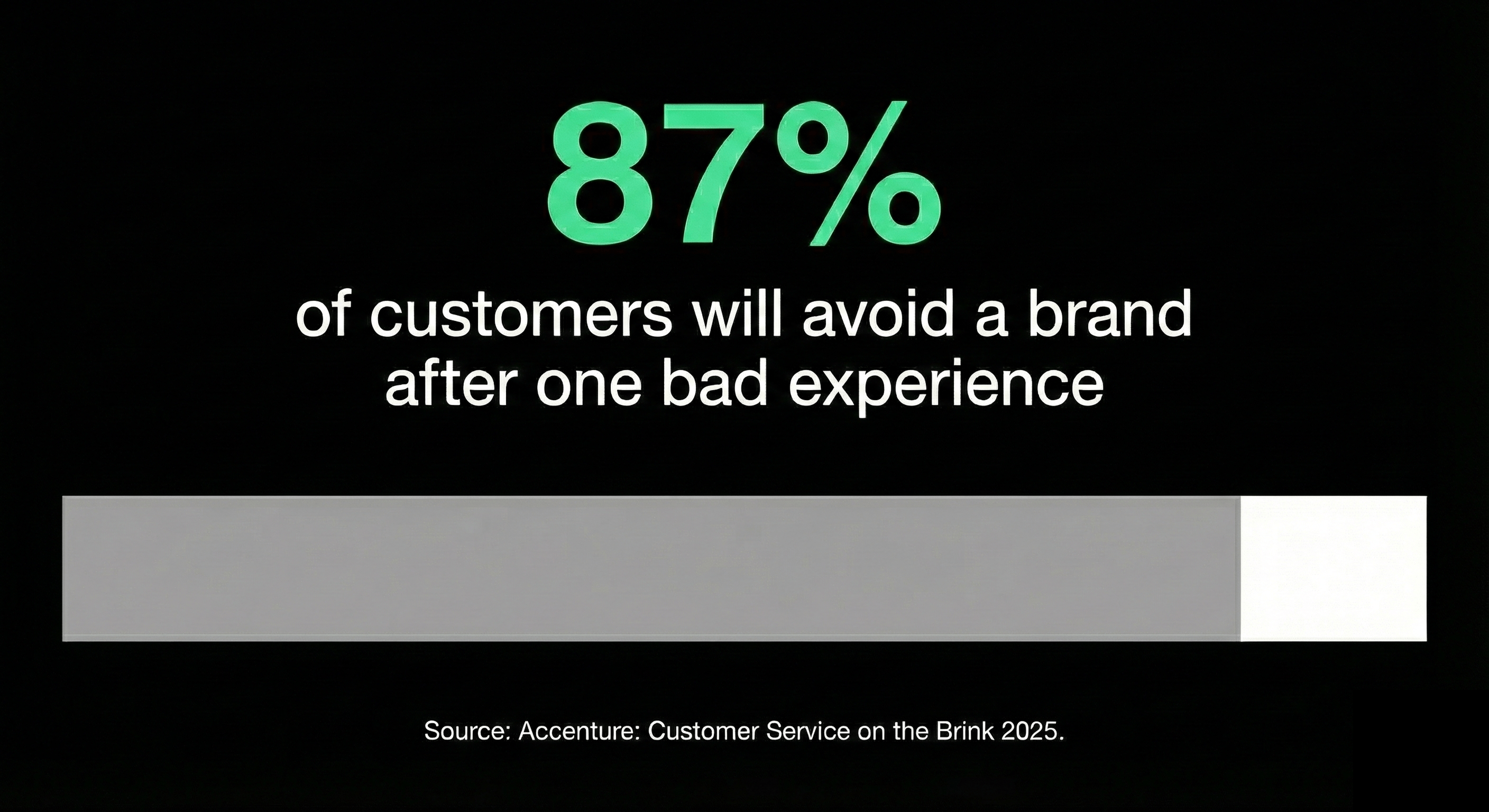
Just as customers are demanding more from service interactions, executives are pulling back. The number of leaders who view customer service as a value creator rather than a cost center has dropped 60% since 2022. Meanwhile, 87% of customers say they'll avoid a brand entirely after a single bad experience.
This is the CX paradox of 2026: the stakes have never been higher, but not every organization is rising to meet them. For CX leaders caught in the middle, the path forward isn't about choosing between cost efficiency and customer satisfaction. The data shows you can deliver both if you know where to focus.
Below are 40+ verified CX statistics defining the landscape for 2026, curated to help you focus your strategy on what drives real results.
Section 1: The State of Global CX in 2026
CX is no longer just a department — it's the primary competitive differentiator.
- 80% of customers say the experience a company provides is as important as its products or services. (Salesforce State of the Connected Customer)
- 87% of customers say they will likely avoid a brand after just a single bad customer service experience. (Accenture: Customer Service on the Brink 2025)
- $75 billion is lost annually by U.S. companies due to poor customer service. (Forbes)
- 43% of customers say they stopped buying from a brand in the last year specifically due to a "poor customer service experience" — ranking it as the #1 driver of churn after price. (Salesforce State of the AI Connected Customer)
- 83% of consumers believe customer experience should be far better than it is today (Zendesk CX Trends 2026)
- Customer-centric companies are 60% more profitable than those not focused on the customer. (Deloitte)
- The number of executives who view customer service as a value creator (rather than a cost center) has dropped by 60% since 2022, and 64% of executives report actively making trade-offs between cost efficiency and customer satisfaction. (Accenture: Customer Service on the Brink 2025)
- "Service Innovator" companies (the top 25% of performers) are 4.6x more likely to report excellent customer satisfaction and 2.5x more likely to report excellent employee satisfaction than their peers. (Deloitte 2024 Global Contact Center Survey)
The Takeaway: The data reveals a stark disconnect: 83% of customers believe service should be far better, yet 60% fewer executives view CX as a value driver than just three years ago. The winners in 2026 won't be the biggest spenders, they'll be the ones who solve for both cost and experience simultaneously.
Section 2: The Contact Center Agent Crisis
The people delivering your customer experience are overwhelmed, undertrained, and leaving — fast.
- 52% is the average annual attrition rate for contact center agents in 2023, a staggering increase from the 38% average recorded in 2022. (Deloitte Digital 2024 Global Contact Center Survey)
- There are approximately 17 million contact center agents globally, and 2.86 million in the U.S. alone. (Gartner / Statista)
- $10,000–$20,000 is the average cost to replace a single contact center agent when factoring in recruiting, training, and lost productivity. (Ibex)
- 60% of contact center agents report that their training provides "no value," contributing directly to early-stage attrition. (SymTrain)
- 61% of contact centers report an increase in emotionally challenging customer interactions. (Calabrio State of the Contact Center 2025)
- 75% of contact center leaders admit their agents are overwhelmed by the number of systems and amount of information they have to navigate. (Deloitte 2024 Global Contact Center Survey)
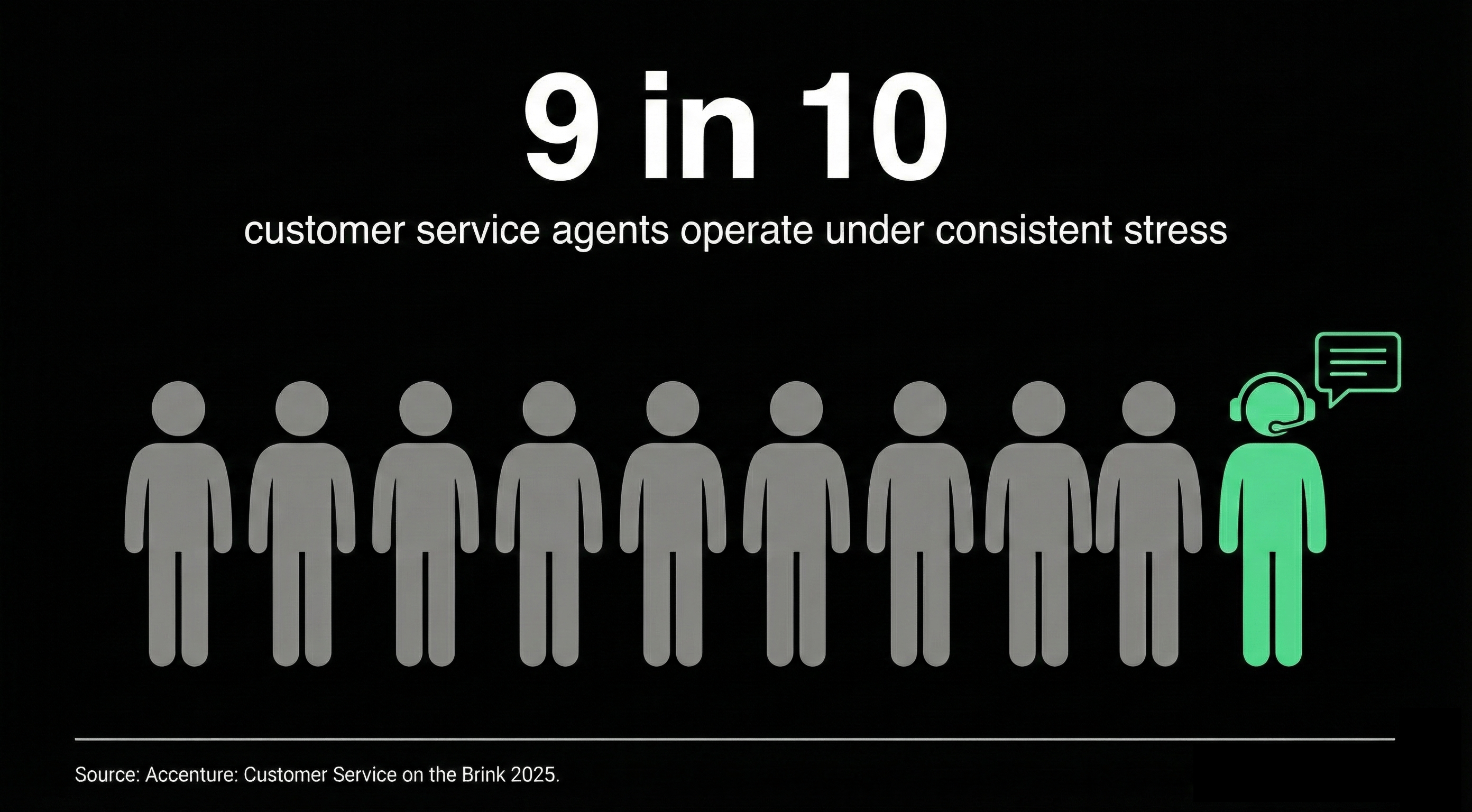
- Only 11% of agents describe their job as "not very stressful" — meaning nearly 9 in 10 operate under consistent pressure. (Calabrio Voice of the Agent Report 2025)
- 35% of agents cite "stressful workloads" and "burnout" as the top reasons for considering leaving their job — ranking it equally with pay. (Calabrio Voice of the Agent Report 2025)
- 75% of agents identify empathy as their strongest skill, yet leaders report it as the skill most lacking in their workforce. (Calabrio Voice of the Agent Report 2025)
- Contact centers that invest in agent career progression report 15% lower annual attrition than those that don't. (Deloitte 2024 Global Contact Center Survey)
The Takeaway: Here's the paradox: 75% of agents say empathy is their strongest skill, yet leaders rank it as the skill most lacking. The problem isn't the people, it's the environment. When 9 in 10 agents operate under consistent stress and 75% are overwhelmed by their own tools, there's no capacity left for the empathy customers demand.
Section 3: Communication Clarity & The "Accent Bias" Factor
The hidden metric most CX reports ignore: how accent and audio quality impact CSAT, resolution time, and customer retention.
- 89% of customers become frustrated when they need to repeat their issues to multiple representatives — often due to communication barriers including accent differences. (Accenture: Customer Service on the Brink 2025)
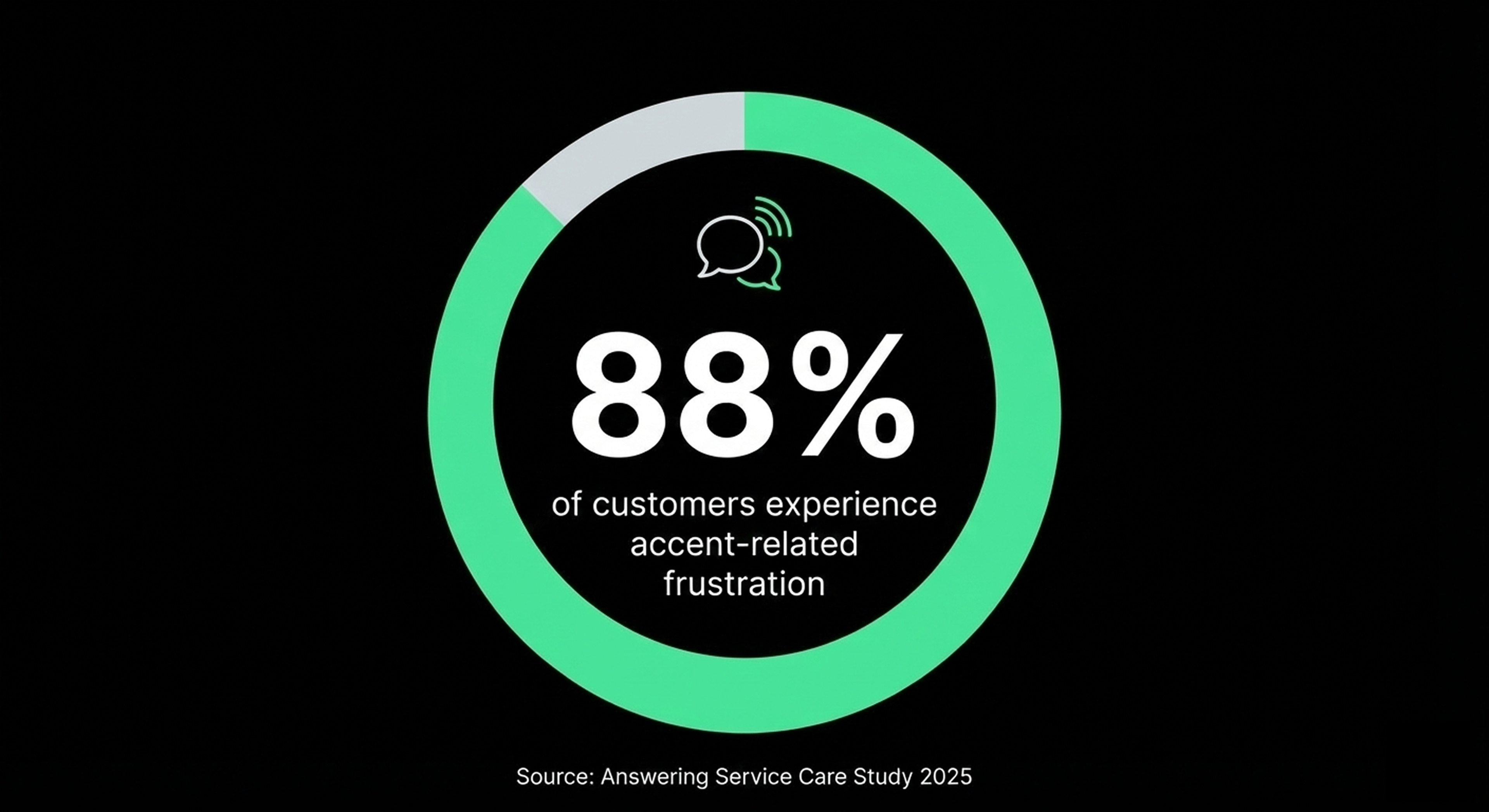
- 88% of customers experience frustration with customer service agents due to accent-related issues. (Answering Service Care Study 2025)
- Over 1/3 of respondents say an accent affects their first impression of someone "a great deal" or "a lot." (Answering Service Care Study 2025)
- Research from the University of Chicago found that listeners are significantly less likely to trust information delivered with a non-native accent, even when the content is identical. (University of Chicago)
- 74% of customers find it frustrating to have to repeat information. (Zendesk CX Trends 2026)
- Customer satisfaction dropped from 79% to 58% when call center operations moved offshore without adequate communication support — a 21-point gap that established the baseline for accent impact measurement. (Zendesk Benchmark)
The Takeaway: "Can you repeat that?" is the most expensive phrase in customer service. It drives up Average Handle Time (AHT), drives down CSAT, and accelerates agent burnout. When 88% of customers report accent-related frustration — and research shows accents reduce perceived trustworthiness — communication clarity isn't a soft metric. It's a revenue driver.
See how Sanas Real-Time Accent Translation improves CSAT and reduces AHT
Section 4: The Impact of Real-Time Accent Translation
Removing the "accent barrier" with real-time speech AI technology doesn’t just improve CSAT — it fundamentally changes who you can hire and how fast they become productive.
- 35% of customers say hearing a familiar regional accent reduces their stress levels during a customer service call. (Answering Service Care Study 2025)
- 29% of customers trust a company more if the salesperson has a "nice" accent, and 35% of customers say a “pleasant” accent can be more persuasive and lead to closing a deal. (Answering Service Care Study 2025)
- Enterprises using Sanas for accent translation have reported a 40% increase in Net Promoter Score (NPS), 33% improvement in first-contact resolution, and a 28% reduction in overall voice-channel costs. (ISG & Sanas: The Clarity Advantage)
- Contact centers have increased their talent pool hiring rate from 10% to nearly 33% by implementing Sanas for accent translation, allowing them to hire for empathy and problem-solving skills instead of prioritizing native-level pronunciation. (Sanas)
- 44% of agents improved one CEFR level by using Sanas for accent translation, 26% improved by two levels, and 21% improved by three levels. (Sanas pilot study)
- Candidates using Sanas for accent translation achieved a 98% pass rate on Versant language assessments (up from 66% without it). (Sanas pilot study)
- Of contact center agent candidates who initially failed language CEFR assessments due to accent, 95% advanced to hirable levels immediately upon using Sanas for accent translation — without altering their natural speech patterns. (Sanas pilot study)

The Takeaway: When 95% of candidates who failed language assessments passed immediately using accent translation — without changing their speech — the implication is clear: organizations have been filtering out qualified talent based on perception, not capability. Accent translation doesn't change who agents are. It changes how they're heard — and expands economic opportunity.
Section 5: AI in CX
AI adoption is accelerating, but customers are wary of being walled off from humans. The opportunity lies in augmentation, not replacement.
- 78% of UK customers are concerned that increasing use of AI in customer service will make it more difficult to reach a human agent. (ContactBabel: UK CX Decision-Makers' Guide 2026)
- 100% of organizations using AI report success in handling more inquiries through self-service, but 80% report they have not seen AI reduce agent headcount. (ContactBabel: US Decision-Makers' Guide 2024-25)
- The global call center AI market is projected to grow from $2.41 billion (2025) to $10.07 billion by 2032 (CAGR 22.7%). (Fortune Business Insights)
- The real-time AI Agent Assist market is projected to grow 28X from $4.4 billion (2024) to $124.6 billion by 2034 — technology that provides real-time assistance to customer service agents during live interactions with customers (Market.us)
- 3 in 5 organizations admit they have been unsuccessful in migrating customers from phone calls to lower-cost digital channels. (Deloitte 2024 Global Contact Center Survey)
- 72% of customers say it is important to know if they are communicating with an AI agent vs. a human. (Salesforce State of the AI Connected Customer)
The Takeaway: The AI Agent Assist market is projected to grow 28x over the next decade — not because companies are replacing agents, but because they're augmenting them. The winners won't be those who deploy AI to deflect customers. They'll be those who use it to make human agents superhuman.
Section 6: What Customers Actually Want
78% of customers prefer humans. 64% of inbound volume is still voice. The channel isn't dying — it's evolving.
- 78% of customers prefer direct interaction with a human customer service agent over digital channels, and 33% of respondents said that dealing with a human employee is essential to resolve any problem effectively. (Accenture: Customer Service on the Brink)
- 36% of callers to US healthcare contact centers have already tried and failed to solve their issue online through self-service before picking up the phone, a figure higher than the contact center average of 21%. (ContactBabel: AI in US Healthcare Verticals 2025)
- 64% of all inbound interactions in the US are still handled by a live telephone agent, dwarfing email (18.9%) and web chat (7.2%). (ContactBabel: US Decision-Makers' Guide 2024-25)
- 82% of customers expect immediate problem resolution from customer service agents. (HubSpot State of Customer Service 2024)
- 74% of consumers now expect customer service to be available 24/7. (Zendesk CX Trends 2026)
- 23% of customers explicitly prefer interacting with an agent who has an accent similar to their own. (Answering Service Care Study 2025)
The Takeaway: Voice isn't dead, it's evolving into the high-stakes channel where experience is decided. When digital self-service fails (as it does 36% of the time in healthcare) or when emotions run high, customers demand a human voice. The question isn't whether voice matters, it's whether your voice channel delivers clarity, empathy, and resolution.
Summary: The CX Leader's 2026 Agenda
What do these CX statistics add up to? A five-point playbook for the year ahead:
- Lead Where Others Are Retreating: While 60% fewer executives view CX as a value driver than in 2022, the opportunity is wide open for those who stay the course. The "Service Innovators" (top 25% of performers) prove it's possible to win on both cost and experience — they're 4.6x more likely to report excellent CSAT. The question isn't whether to invest, but where.
- Unlock the Empathy That's Already There: 75% of agents say empathy is their greatest strength — the capacity is there, waiting to be released. When leaders reduce system overload and address the stress that 9 in 10 agents operate under, they don't need to train for empathy. They just need to make room for it.
- Turn Clarity Into a Competitive Advantage: When 88% of customers experience accent-related frustration and satisfaction drops 21 points after offshoring without communication support, solving for clarity creates immediate differentiation. Every conversation that doesn't require "Can you repeat that?" is faster, warmer, and more likely to resolve on first contact.
- Augment Your Best People: 78% of customers prefer humans. 72% want to know if they're talking to AI. The AI opportunity isn't replacing agents — it's making every human interaction clearer, faster, and more effective. The Agent Assist market is growing 28x by 2034 because augmentation works.
- Invest in Retention, Reap the Returns: Centers that invest in career progression see 15% lower attrition — and at $10K–$20K per replacement, that's a seven-figure opportunity for most operations. The 52% attrition rate isn't inevitable. It's a problem with a proven solution.
Ready to future-proof your CX operations in 2026?
The data says that 78% of customers prefer to speak to a human agent. The question isn't whether voice matters, it's whether your voice channel delivers clarity, empathy, and resolution.
Sanas’ real-time accent translation technology enables agents to focus on the customer, not their accent. The result is clearer conversations, faster resolution, higher CSAT, and agents who get to focus on what they were hired for: empathy, problem-solving, and creating great experiences.


