When AI Needs Help, the Customer Shouldn’t Have to Start Over
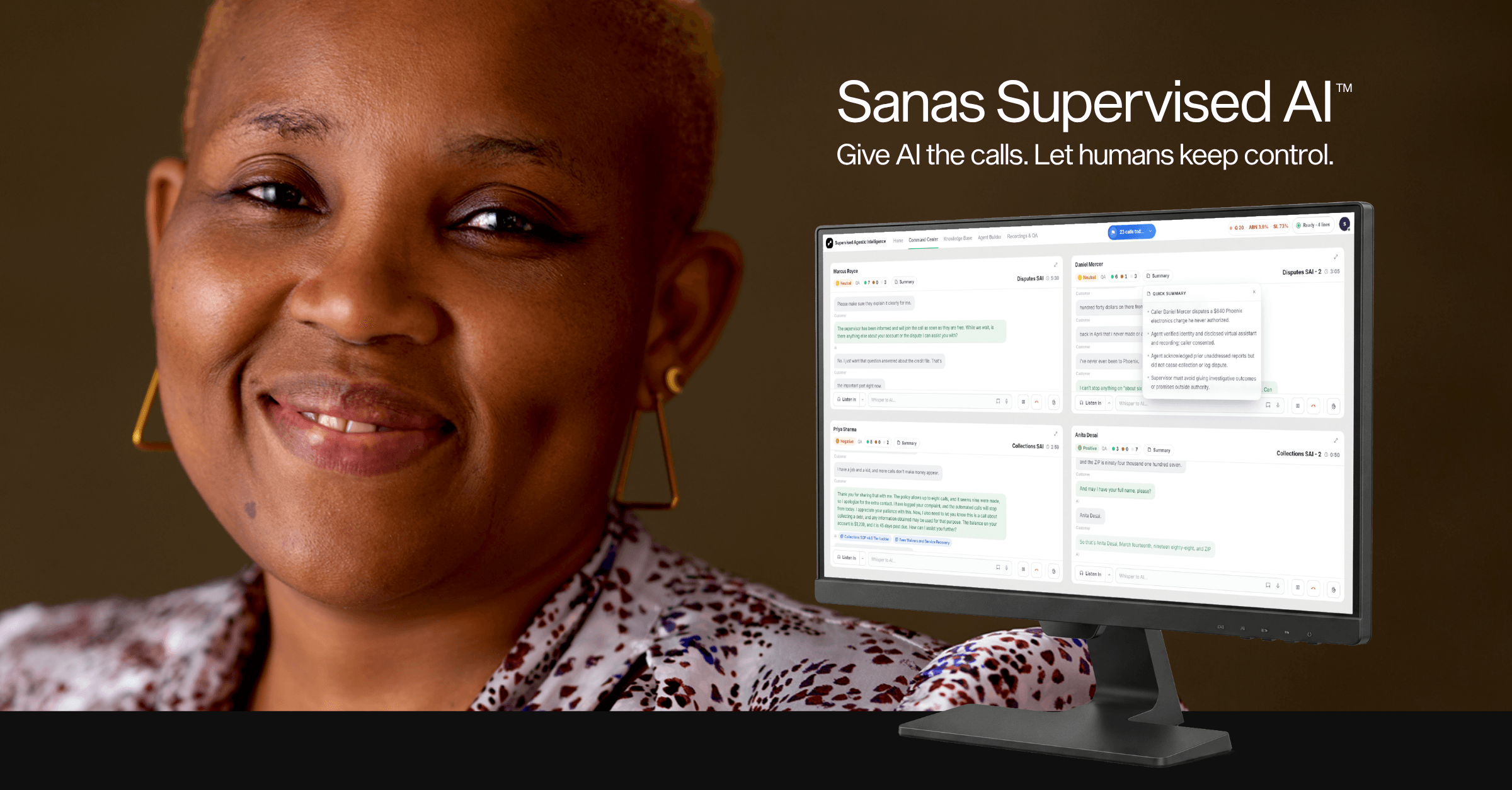
Introducing Sanas Supervised AI
Contact centers already know that when AI automation reaches its limit, it’s time to escalate to a person. There’s a flaw in this handoff, though. A human can enter the conversation without having been a part of it, context may need to be rebuilt, and the customer can end up repeating themselves.
Sanas Supervised AI takes a different approach. AI handles the conversation until human judgment is needed. A supervisor who has been following the interaction can step in directly, take control without a separate transfer, and hand the conversation back to AI when the moment has passed. The customer stays in the same conversation throughout.
That changes the role of the human. They are no longer just the destination at the end of an escalation path. They can move in and out of the conversation as needed while AI continues to handle the work it can manage on its own.
Sanas Supervised AI comes at a moment when enterprises are trying to strike a balance, putting more responsibility in the hands of AI agents, while keeping humans meaningfully involved. In a 2025 survey of 7,950 business and technical decision-makers across 30 countries, Cisco found that respondents expected 68% of their customer experience interactions with technology partners to be handled using agentic AI within three years. At the same time, 89% emphasized combining human connection with AI efficiency.
The fact that contact centers are processing more AI-led conversations doesn’t remove the need for human judgment. On the contrary, it highlights the critical importance of having a strong POV about when people should step in. And, when that trigger happens, having a robust mechanism in place to do so.

When should a human intervene in an AI customer service conversation?
A human should be able to intervene when a conversation reaches a decision the AI shouldn’t make alone, or when the interaction begins to require judgment that goes beyond routine execution.
That moment won’t always announce itself neatly. A straightforward billing question, for instance, can become a disputed charge. A request can reach a policy edge case. Also, with compliance, some steps can require extra attention.
The phrase “human in the loop” is familiar to anyone who spends any time thinking about AI, but it can hide an important distinction. Knowing that a person exists somewhere in the process does not tell you when that person arrives, what context they already have, or how quickly they can act. There’s a meaningful difference between post-action review and real-time involvement.
Customers are also paying attention to how AI enters these interactions. Salesforce found that 72% of customers say it is important to know when they are communicating with an AI agent.
Not every consequential conversation requires a person to take over. But as humans and AI work together more and more, this is exactly why enterprises need a way to bring human judgment into the interaction when the situation calls for it.
What happens when a human joins only after escalation?
When a human joins only after an escalation, they may need to reconstruct context, and the customer may need to adjust to a new participant or repeat information.
That doesn’t make escalation inherently bad. There are plenty of situations where a transfer is appropriate, but often the process is a bad experience for the customer.
With Sanas Supervised AI, a supervisor can monitor multiple live conversations, receive alerts when one needs attention, listen in, steer the AI privately, take over, and hand control back. The customer remains inside the same conversation.
As Sanas CEO and co-founder Sharath Keshava Narayana put it:
“What enterprises won’t accept, and shouldn’t, is the idea that adopting agentic AI means giving up judgment and accountability the moment a call gets complicated.”
The crucial distinctions between traditional AI contact center deployments and Supervised AI are timing and mechanism. The supervisor isn’t sitting at the end of an exception path waiting for a failed interaction to arrive. Instead, they already have visibility into the conversation and a way to act while it’s happening.
What changes when human intervention happens in real time?
Real-time intervention gives a person the chance to affect an AI-led conversation before the only remaining option is a separate handoff, with (maybe) a lesson learned in retrospective review.
That idea has a parallel in the broader discussion around agentic AI governance. IBM argues that systems with greater autonomy require controls that operate closer to execution, describing a necessary shift in governance “from review to runtime.” This includes continuous monitoring, authority limits, and human intervention when necessary.
Supervised AI does not replace the governance processes enterprises already use. Every AI action and human intervention is recorded, giving the call an audit trail for later review. Recommendations made to the supervisor cite the source document behind them.
What it adds is a live human always on the call.
Consider a routine customer call that changes direction halfway through. The system detects that the conversation needs attention. The supervisor can listen, privately guide the AI, or take over directly. If the situation is resolved, control can return to the AI without starting another conversation.
Sanas Supervised AI is designed for one supervisor to govern up to four simultaneous conversations. The operating model is different from assigning one person to conduct every call, but it also differs from letting AI run independently until it reaches a transfer point.
The human is still accountable for the moments that need human judgment. But they don’t have to manually conduct every moment leading up to them.
What does Sanas Supervised AI look like for the customer?
For the customer, Supervised AI is designed to preserve one continuous conversation even when control moves between AI and a human supervisor.
Every Supervised AI call begins with disclosure that the customer is speaking with AI and that a human supervisor is in command. If the supervisor takes over, the customer does not have to start a new interaction. When appropriate, the supervisor can hand the conversation back to the AI.
That makes continuity part of the operating model rather than something the customer has to maintain themselves.
A conventional handoff can put that burden back on the customer. We’ve all experienced the exquisite frustration of being asked, for the second or third time, “Who were you speaking with? What have you already tried? Can you explain the problem again?” Of course, sometimes those questions are unavoidable, but they shouldn’t be the default consequence of needing human judgment.
Supervised AI creates another option. AI can continue handling the parts of the interaction it can manage, while a person remains close enough to enter the conversation when necessary.
From helping people be understood to putting them in command
Sanas began by using real-time speech AI to help people understand one another more clearly across accents, languages, and difficult audio environments. As voice becomes an interface for AI agents, the infrastructure behind those conversations has another job to do.
Supervised AI brings that philosophy into the AI-led call itself.
The industry is going to keep asking how much more work AI agents can do. That is a useful question, but it is not the only one enterprises need to answer.
They also need to decide when and how a person should be able to take and relinquish the controls.
Our answer is Sanas Supervised AI.
Read more in our press release.